When Is It Time to Consider Shoulder Replacement? 7 Signs You May Be Ready
Shoulder arthritis often progresses slowly. At first, the discomfort may be manageable with activity changes, medication, an injection, or simply avoiding movements that aggravate the joint. Over time, however, the pain and stiffness can begin to affect sleep, work, exercise, and ordinary daily activities.
Patients often ask me, “How do I know when my shoulder is bad enough for replacement?”
There is no single test, X-ray finding, or pain score that answers that question for everyone. Shoulder replacement is usually worth considering when three things come together:
The shoulder has a clearly diagnosed problem that can be treated with replacement.
Pain or loss of function is meaningfully affecting your quality of life.
Reasonable nonsurgical treatments are no longer providing acceptable relief.
Here are seven signs that it may be time to discuss shoulder replacement with an orthopedic shoulder specialist.

1. Shoulder Pain Is Regularly Disrupting Your Sleep
Night pain is one of the most common reasons patients decide their shoulder problem is no longer tolerable.
You may have difficulty finding a comfortable position, wake repeatedly when you roll onto the affected side, or need to sleep in a recliner. Some patients can fall asleep but wake several hours later with a deep ache in the shoulder.
One or two bad nights do not necessarily mean you need surgery. However, when shoulder pain consistently interferes with restorative sleep, it can affect your energy, concentration, mood, and overall health.
Persistent night pain is a sign that the condition is having an impact beyond the shoulder itself.
2. Everyday Activities Have Become Difficult
The decision to consider shoulder replacement is often less about a number on a pain scale and more about what the shoulder prevents you from doing.
Common examples include difficulty:
Reaching a shelf or cupboard
Washing or styling your hair
Getting dressed
Putting on a coat
Fastening a seat belt
Reaching behind your back
Carrying groceries
Performing household work
Participating in hobbies or exercise
Completing the physical demands of your job
Patients sometimes adapt so gradually that they do not realize how much they have changed their routines. They begin using the opposite arm for nearly everything, stop certain activities, or rely more heavily on a spouse or family member.
Those adaptations are reasonable for a while. However, when the shoulder is steadily reducing your independence or preventing activities that matter to you, replacement may become a reasonable option.

3. The Shoulder Is Becoming Progressively Stiffer
Shoulder arthritis does not cause pain alone. It can also cause substantial stiffness.
The cartilage that normally allows the ball and socket to move smoothly becomes thin or disappears. The joint may develop bone spurs, inflammation, and changes in its shape. As the disease progresses, motion can become increasingly limited and painful.
You may notice that you can no longer raise the arm overhead, reach the back of your head, or rotate the arm normally. The shoulder may grind, catch, or feel as though it is moving through a restricted arc.
Some stiffness can improve with stretching or therapy. However, severe stiffness caused by advanced joint damage may not respond adequately because the limitation is mechanical rather than simply muscular.
Shoulder replacement does not guarantee perfectly normal motion, but it is designed to replace the damaged joint surfaces and allow the shoulder to move with less pain.
4. X-Rays Show Advanced Joint Damage
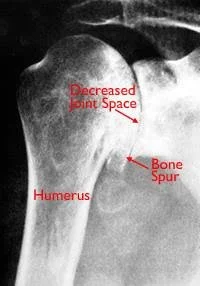
X-rays are an important part of evaluating shoulder arthritis. They can show:
Loss of the normal joint space
Bone-on-bone contact
Bone spurs
Changes in the shape of the ball or socket
Erosion or wear of the socket
Changes related to an old fracture
Abnormal positioning of the joint
Advanced arthritis on an X-ray helps confirm the diagnosis, but an X-ray alone is not a reason to have surgery.
Some patients have dramatic X-ray changes but remain active and reasonably comfortable. Others have substantial pain and limitations with findings that appear less severe.
I do not recommend shoulder replacement simply because an X-ray looks bad. The imaging must match the patient’s symptoms, physical examination, goals, and overall clinical picture.
5. Injections Provide Little Relief or the Relief Does Not Last
A corticosteroid injection can be helpful for some patients with shoulder arthritis. It may reduce inflammation and provide enough relief to sleep better, remain active, or postpone surgery.
The response varies. An injection may provide substantial relief for months, brief improvement, or no meaningful benefit.
A short-lived response does not automatically mean that surgery is required. However, if injections are becoming less effective, wearing off rapidly, or failing to improve the symptoms at all, the value of continuing them may be limited.
Repeated injections should not become a way of indefinitely postponing a decision when the shoulder remains severely painful and disabling. At that point, it is reasonable to discuss whether replacement is more likely to provide durable improvement.
6. Medication, Activity Changes, and Other Treatments Are No Longer Enough
Most patients should try appropriate nonsurgical care before proceeding with an elective shoulder replacement.
Depending on the diagnosis and the patient’s health, this may include:
Modifying painful activities
Anti-inflammatory or pain medication when medically appropriate
Ice or heat
A home exercise program
Physical therapy in selected cases
A corticosteroid injection
Allowing time to see whether symptoms improve
Not every patient needs to complete every treatment on this list. Treatment should be individualized.
For example, physical therapy can help maintain motion and strength, but aggressive therapy may aggravate a severely arthritic joint. Similarly, medication may not be appropriate for patients with certain kidney, stomach, heart, or bleeding concerns.
The relevant question is not whether you have exhausted every conceivable option. It is whether you have tried reasonable treatments and still find the shoulder unacceptable.
7. The Shoulder Is Meaningfully Limiting Your Quality of Life
Shoulder replacement is generally an elective procedure. That means the timing depends partly on the individual patient’s priorities.
One patient may tolerate limited overhead motion but feel strongly about maintaining sleep and basic independence. Another may be comfortable at rest but unable to perform an important job, sport, or hobby. A third may decide that symptoms are manageable and prefer to wait.
There is no prize for delaying surgery as long as possible. There is also no reason to rush into surgery when symptoms remain manageable.
A useful question is:
“Is my shoulder preventing me from living in a way that is acceptable to me, and are the remaining nonsurgical options likely to change that?”
When the answer is yes to the first part and no to the second, it may be time to seriously consider shoulder replacement.
Signs You May Not Be Ready for Shoulder Replacement
Not every painful shoulder needs replacement.
You may not be ready if:
Symptoms began recently and have not yet been fully evaluated.
The pain is mild or intermittent.
You are still sleeping reasonably well.
Daily activities remain manageable.
Nonsurgical treatments are providing acceptable relief.
The pain comes primarily from the neck, rotator cuff, biceps, or another condition rather than the shoulder joint.
The imaging findings do not match your symptoms.
You are not prepared for the recovery or postoperative restrictions.
Your medical health needs to be optimized before elective surgery.
A single painful week, an isolated flare, or an alarming X-ray report does not automatically justify surgery.
The first step is making the correct diagnosis.
Symptoms Matter More Than the X-Ray Alone
One of the most important parts of a shoulder replacement evaluation is determining whether the damaged joint is truly responsible for the patient’s symptoms.
Shoulder pain can come from several sources, including:
Glenohumeral arthritis
A large or irreparable rotator cuff tear
Rotator cuff tendinitis or bursitis
Biceps problems
Acromioclavicular joint arthritis
A prior fracture
Instability
The neck or cervical spine
Nerve conditions

Replacement is effective only when it addresses the actual source of the problem.
The evaluation typically includes a detailed discussion of the symptoms, a physical examination, and shoulder X-rays. An MRI or CT scan may be ordered when additional information is needed about the rotator cuff, bone structure, or surgical planning.
Anatomic or Reverse Shoulder Replacement?
There are two main types of total shoulder replacement.
Anatomic Total Shoulder Replacement
An anatomic replacement recreates the shoulder’s normal ball-and-socket arrangement. It is commonly considered for arthritis when the rotator cuff is intact and functioning well.
Reverse Total Shoulder Replacement
A reverse replacement changes the orientation of the ball and socket. It allows the deltoid muscle to play a larger role in raising the arm and may be used when the rotator cuff is severely damaged, when bone loss is present, after certain fractures, or in some revision procedures.
The best choice depends on the condition of the rotator cuff, the pattern of arthritis, the shape and quality of the bone, prior surgery, age, activity goals, and other individual factors.
The decision should be based on the replacement that provides the best chance of meeting your goals, not simply on which implant is newer.
What Should You Expect at a Shoulder Replacement Consultation?
A consultation does not obligate you to have surgery.
The purpose is to answer several questions:
What is causing the pain?
How advanced is the problem?
Are there reasonable nonsurgical options remaining?
Is shoulder replacement likely to improve the symptoms that matter most to you?
Which type of replacement would be most appropriate?
What are the risks, limitations, and expected recovery?
Is this the right time for surgery, or is continued observation reasonable?
Our role is not simply to list options. It is to understand what the patient is trying to regain and explain which option offers the best chance of reaching those goals.
Sometimes the recommendation is shoulder replacement. Sometimes it is an injection, a different treatment, additional testing, or continued observation.
The Bottom Line
Shoulder replacement becomes reasonable when pain and loss of function are significant, the diagnosis is clear, and appropriate nonsurgical treatments are no longer providing an acceptable quality of life.
The seven signs are:
Pain regularly disrupts sleep.
Daily activities are becoming difficult.
The shoulder is progressively stiff.
Imaging confirms advanced joint damage.
Injections provide limited or short-lived relief.
Other reasonable treatments are no longer enough.
The shoulder is meaningfully limiting your life.
You do not need to wait until the shoulder is completely unusable. You also should not have replacement based solely on an X-ray.
A careful evaluation can help determine whether surgery is appropriate now, later, or not at all.
Schedule a Shoulder Evaluation in Northern Michigan
If shoulder pain or stiffness is interfering with sleep, independence, work, or the activities you value, an evaluation can help clarify the diagnosis and available treatment options.
Matthew Dubiel, MD is an orthopedic shoulder and elbow surgeon serving Traverse City and Northern Michigan.
This article is intended for general educational purposes and does not replace an individual medical evaluation. Treatment recommendations vary based on the diagnosis, examination, imaging, medical history, and patient goals.