Robotic-assisted surgery has become increasingly common in orthopedics, particularly in hip and knee replacement. More recently, similar technology has become available for shoulder replacement surgery.
For patients considering a shoulder replacement, the term “robotic surgery” can be confusing. What exactly does it mean? How is it different from a traditional shoulder replacement? And what potential advantages does it offer?
What Is Robotic Shoulder Replacement?
Robotic shoulder replacement combines several technologies that help the surgeon plan and perform the operation with greater precision.
The process typically begins with a CT scan of the shoulder. This scan is used to create a three-dimensional model of the patient’s anatomy.
Using that model, the surgeon can plan the shoulder replacement before entering the operating room.
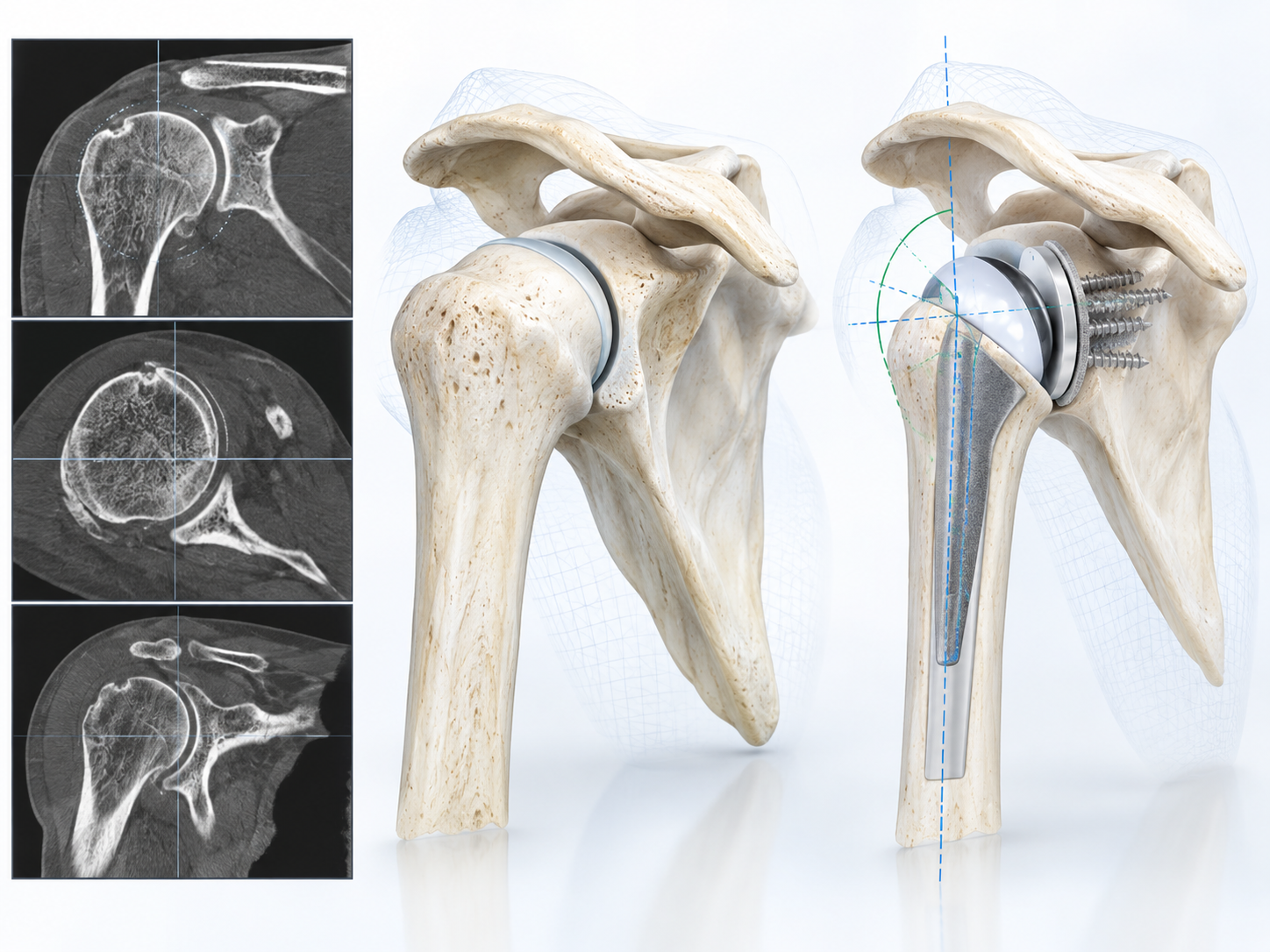
The plan can include:
Implant size and position
Orientation of the shoulder socket
Amount and location of bone removal
Areas of bone loss or deformity
Selection of standard or augmented implants
The relationship between the implants and the patient’s individual anatomy
This detailed planning is particularly useful because arthritic shoulders can look very different from one patient to another.
Why Is Three-Dimensional Planning Important?
Shoulder arthritis does not always wear the joint evenly.
In some patients, the shoulder socket remains relatively well preserved. In others, years of arthritis can produce substantial bone loss, flattening, angulation, or other deformity.
Traditional X-rays remain important, but a CT-based three-dimensional model gives the surgeon a much more complete understanding of the shape of the joint.
This allows the surgeon to plan the replacement around the patient’s anatomy rather than relying only on measurements made during surgery.
Where Does Robotic Assistance Come In?
Once the operation has been planned, robotic technology can help the surgeon reproduce that plan in the operating room.
The system uses information about the patient’s anatomy together with the preoperative plan to assist with preparation of the bone and placement of the shoulder replacement components.
The goal is to improve the surgeon’s ability to place the implants in the intended position and orientation.
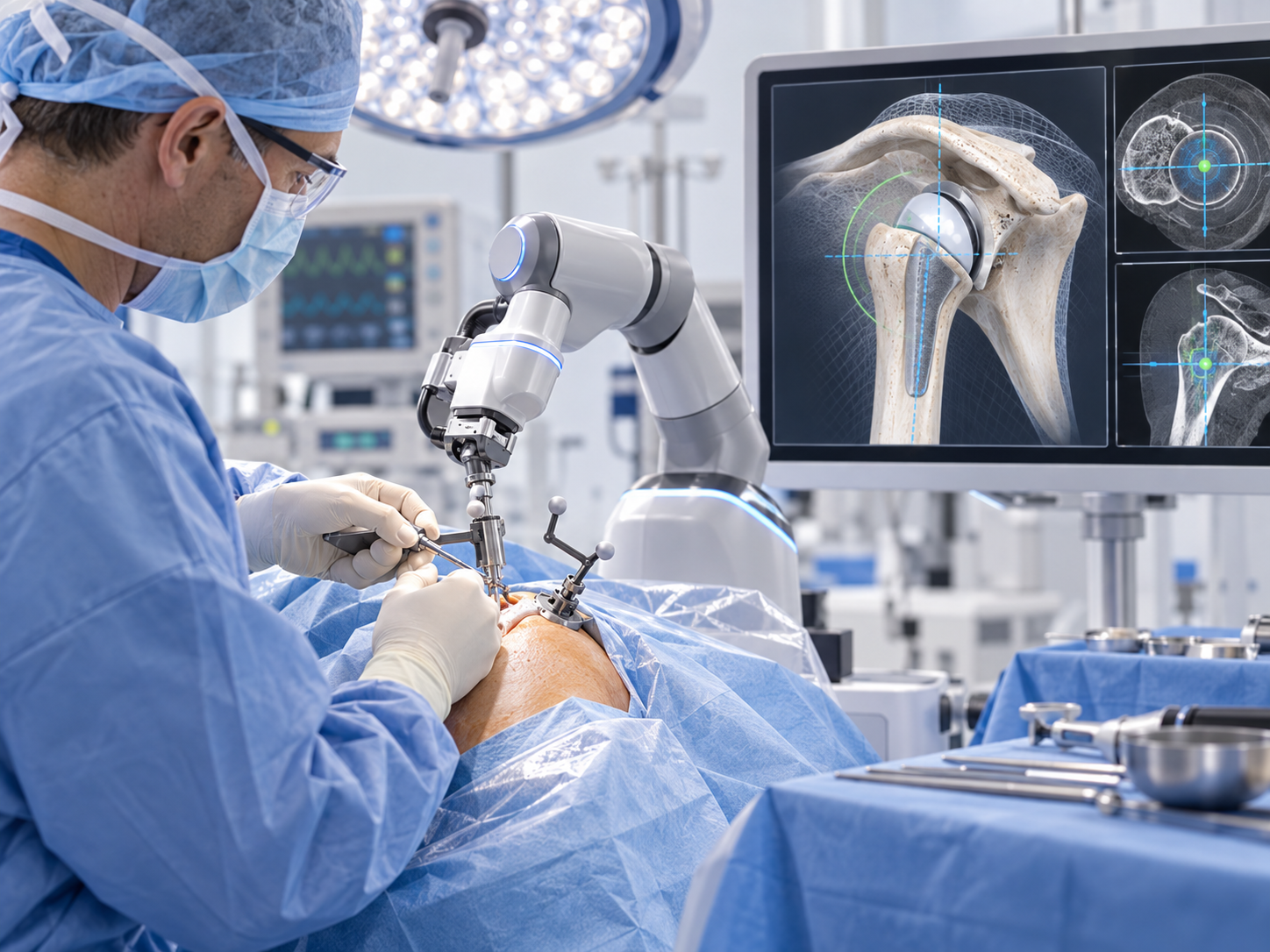
This is important because shoulder replacement is not simply a matter of replacing an arthritic ball and socket. Implant position affects several aspects of the reconstruction, including:
Stability
Range of motion
Bone preservation
Soft-tissue tension
Joint mechanics
Implant fixation
Small differences in implant positioning can matter, particularly in patients with substantial deformity or bone loss.
Can Robotics Be Used for Both Types of Shoulder Replacement?
Yes.
Robotic-assisted technology can be used in both anatomic total shoulder replacement and reverse shoulder replacement.
Anatomic shoulder replacement is generally used when the rotator cuff is functioning well and the anatomy of the shoulder can be reconstructed in a more traditional fashion.
Reverse shoulder replacement changes the mechanics of the joint and is commonly used in patients with rotator cuff deficiency, certain fractures, substantial bone loss, and other complex shoulder conditions.
Three-dimensional planning can be helpful with either operation.
What Are the Potential Advantages?
The main potential advantages of robotic-assisted shoulder replacement are related to planning and precision.
These include:
More detailed evaluation of the patient’s individual anatomy
Ability to plan implant size and position before surgery
Improved ability to account for bone loss and deformity
Greater accuracy in reproducing the surgical plan
More consistent component positioning
For some patients, especially those with unusual anatomy or significant wear of the shoulder socket, these tools may be particularly useful.
Does Robotic Surgery Improve Shoulder Replacement Results?
This is still being studied.
Research has shown that computer-based planning and robotic assistance can improve the accuracy of implant positioning. That is an important technical advantage.
However, long-term studies are still needed to determine how much robotic assistance changes outcomes such as pain relief, function, complications, implant longevity, and the need for revision surgery.
In other words, improved precision is promising, but it should not be confused with a guarantee of a better clinical result.
Technology Is One Part of Shoulder Replacement
Shoulder replacement has advanced considerably over the past several decades.
Modern implants, improved imaging, three-dimensional planning, patient-specific instrumentation, navigation, and now robotic assistance all give surgeons more information and more tools than were available in the past.
But technology is only one part of the operation.
A successful shoulder replacement still depends on appropriate patient selection, choosing the correct type of replacement, understanding the patient’s anatomy, sound surgical technique, and appropriate postoperative care.
Robotic assistance is best viewed as another tool that can help surgeons plan and perform shoulder replacement as accurately and reproducibly as possible.
The Future of Shoulder Replacement
Robotic-assisted shoulder surgery is still relatively new compared with robotic hip and knee replacement, but its role is likely to continue growing.
As the technology improves and longer-term clinical data become available, we will learn more about which patients benefit most and how robotic assistance may affect long-term shoulder replacement outcomes.
For now, its greatest strengths are clear: better visualization of individual anatomy, detailed preoperative planning, and greater precision in carrying that plan into the operating room.