Cortisone Injections for Shoulder Pain: When They Help, When They Don’t, and When to Be Careful
Cortisone injections can be a useful treatment for shoulder pain. They are commonly used because they are relatively quick, low cost, and can reduce inflammation enough to help patients sleep better, move better, and participate in therapy or home exercises.
That said, cortisone is not a cure for most structural shoulder problems. It is best thought of as a tool — sometimes a very helpful one — but not a long-term plan by itself.
The most important question is not simply, “Can I get an injection?” The better question is, “Is this the type of shoulder problem where an injection is likely to help, or is it mainly delaying the treatment I actually need?”
The short version
A cortisone injection may be reasonable when the goal is to reduce pain and inflammation, especially if the shoulder problem is being treated without surgery.
Shoulder surgeons are often more cautious with cortisone injections when the shoulder problem is likely surgical. In those cases, an injection may give temporary relief, but it can also delay appropriate care, complicate surgical timing, or create concerns about tissue healing and infection risk.
Common shoulder-surgery guidelines include:
Cortisone can be worth trying for selected shoulder conditions.
It is not usually a long-term treatment plan.
Injections should generally be spaced at least 3 months apart.
Cortisone injections are generally avoided within 3 months of planned shoulder replacement surgery.
Cortisone is used cautiously when a rotator cuff repair may be needed.
Repeated injections are usually not recommended for problems that are clearly structural or surgical.
Repeated injections often have diminishing returns.
The risks are usually low, but they are not zero.
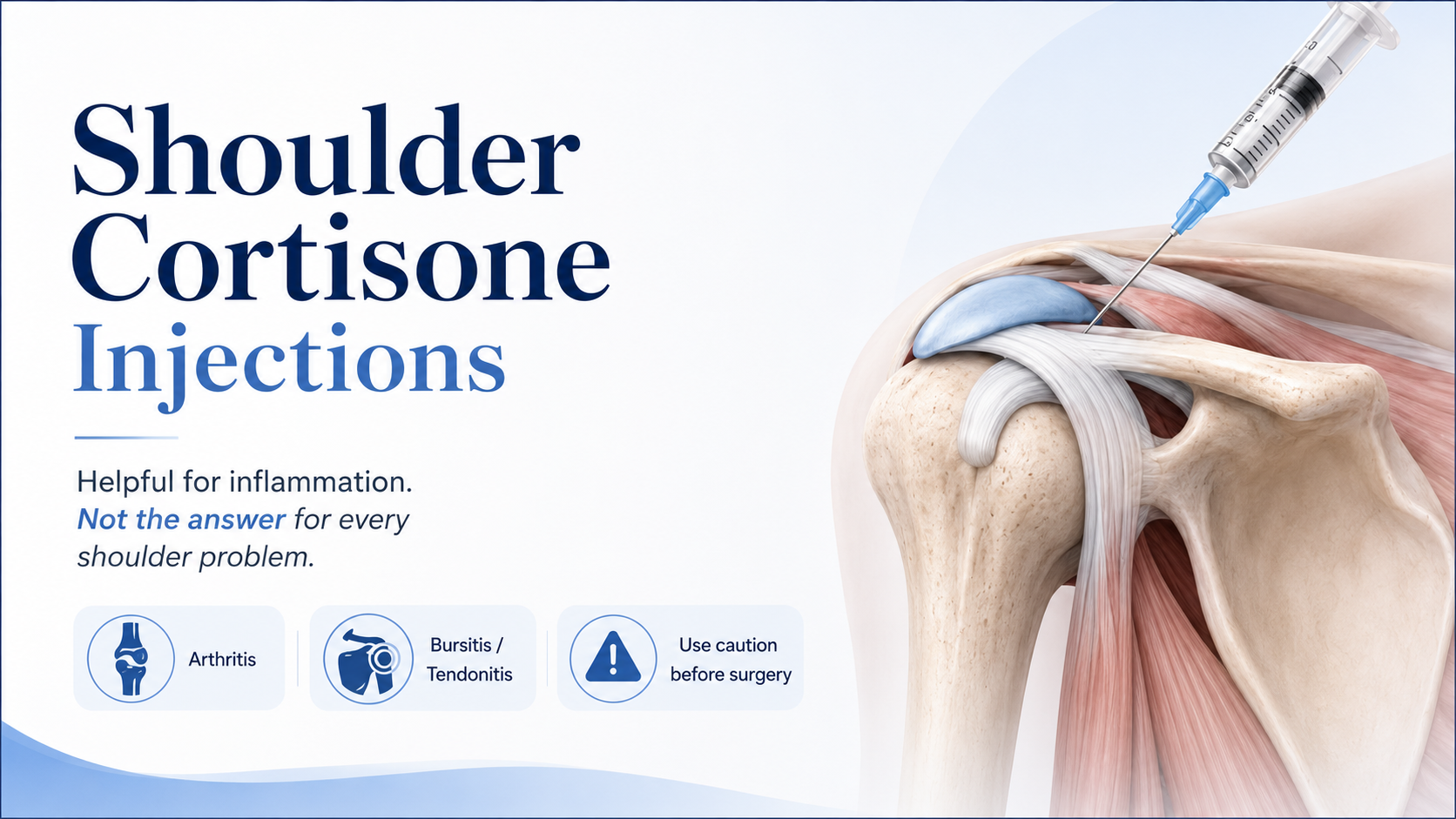
What is cortisone?
“Cortisone” is a common term for a corticosteroid medication. It is an anti-inflammatory medicine. In the shoulder, it may be injected into the shoulder joint, the space above the rotator cuff, the acromioclavicular joint, or around an inflamed biceps tendon, depending on the diagnosis.
The goal is not to “numb” the shoulder permanently or hide a dangerous problem. The goal is to calm inflammation so the shoulder can function better.
When cortisone injections can be helpful
Cortisone injections may be useful for:
Shoulder arthritis when surgery is not planned soon
Frozen shoulder
Bursitis or rotator cuff tendinitis without major weakness
AC joint arthritis
Selected cases of biceps-related inflammation
Pain that is limiting sleep, daily activity, or physical therapy
The best results are usually seen when the pain is coming from inflammation rather than a major mechanical or structural problem.
When cortisone may not be the right answer
Some shoulder problems are mostly inflammatory. Others are mostly structural. Cortisone is much better at treating inflammation than fixing structure.
Shoulder surgeons are more likely to steer patients away from injections when the symptoms suggest a problem that may need surgery, such as:
A traumatic rotator cuff tear
New weakness after an injury
A full-thickness rotator cuff tear in an active patient
Advanced shoulder arthritis with severe pain and loss of function
A shoulder that has already failed several injections
A problem where surgery is already being actively considered
In these situations, cortisone may still reduce pain temporarily, but it does not repair the tendon, rebuild cartilage, restore strength, or correct joint mechanics. If the shoulder problem is likely surgical, the better next step is often a clear diagnosis and a focused treatment plan — not another injection.
Cortisone for shoulder arthritis
For shoulder arthritis, cortisone can be a reasonable nonsurgical option. It may reduce pain and improve function for a period of time. This can be especially helpful for patients who are not ready for shoulder replacement or who want to delay surgery.
However, cortisone does not rebuild cartilage, reverse arthritis, or change the underlying shape of the joint. If arthritis is advanced, injections may help temporarily but usually become less effective over time.
For arthritis, cortisone is often most appropriate when:
Symptoms are bothersome but manageable
Surgery is not desired yet
The patient needs short-term relief for sleep, travel, work, or activity
The injection is being used as part of a broader plan, not as repeated maintenance forever
For advanced arthritis, repeated injections can become a cycle: temporary relief, then recurring pain, then another injection. That may be reasonable for some patients who are not surgical candidates or who strongly prefer to avoid surgery. But for healthy patients with severe arthritis who are otherwise good candidates for shoulder replacement, repeated injections often delay the more definitive treatment.
If shoulder replacement is being considered, timing matters. Shoulder surgeons generally avoid cortisone injections within 3 months of shoulder replacement surgery because of concern for increased infection risk.
Cortisone for rotator cuff pain
For rotator cuff irritation, bursitis, or tendinitis, a cortisone injection can sometimes be useful. It may reduce pain enough to allow better stretching, strengthening, and sleep.
But rotator cuff problems are not all the same. A sore, inflamed tendon is different from a torn tendon that is unlikely to heal without surgery.
Shoulder surgeons are more cautious with cortisone when:
There is a full-thickness rotator cuff tear
The patient has significant weakness
The injury was sudden or traumatic
The patient is likely to need rotator cuff repair
Surgery is already being actively discussed
In those situations, an injection may delay the right treatment or create avoidable concerns around tendon health, healing, and surgical timing. If a rotator cuff repair is likely, it is often better to get appropriate imaging and make a clear treatment plan rather than repeatedly injecting the shoulder.
A cortisone injection may make sense for rotator cuff inflammation. It is less attractive when the real problem is a repairable tear that needs timely evaluation.
Why I do not recommend repeated injections as a long-term plan
Cortisone can work well, but repeated injections are not harmless. Over time, patients often notice that each injection helps less or does not last as long. This is what people mean by “diminishing returns.”
Repeated injections may also raise concerns about:
Temporary blood sugar elevation, especially in patients with diabetes
Facial flushing or short-term systemic side effects
Skin or soft-tissue thinning near the injection site
Infection, although uncommon
Possible effects on tendon quality, especially around the rotator cuff
Surgical infection risk if performed too close to shoulder replacement
For these reasons, Cortisone injections are generally not recommended every few weeks or as an indefinite routine.
How often can injections be done?
A common rule is to space injections by at least 3 months when repeat injections are appropriate. That does not mean every patient should automatically receive injections every 3 months. It simply means that injections closer together are usually avoided.
The better question is: “Why are we repeating the injection?”
If the first injection gave excellent relief for a long period of time, repeating it may be reasonable. If the injection did not help much, wore off quickly, or the shoulder is getting weaker, then repeating injections may not be the right answer.
When I usually avoid cortisone injections
Shoulder surgeons usually avoid or strongly reconsider cortisone injections when:
Shoulder replacement surgery is planned within the next 3 months
Rotator cuff repair is likely
There is a traumatic rotator cuff tear with weakness
Prior injections have stopped helping
The diagnosis is unclear and imaging or further evaluation is needed first
There is active infection or a major concern for infection
Blood sugar control is poor and the risks outweigh the benefit
A practical way to think about cortisone
Cortisone is often safe, cheap, and easy compared with many other treatments. It can be a good option when used for the right diagnosis and at the right time.
But it should not become a way to avoid making a diagnosis. It should not be used repeatedly when the shoulder is clearly failing. And it should not be used too close to a planned surgery.
The goal is to match the treatment to the problem:
Arthritis: cortisone may help manage symptoms, but it does not reverse arthritis.
Rotator cuff inflammation: cortisone may help pain and therapy progress.
Rotator cuff tear likely needing repair: be cautious; imaging and surgical planning may be more appropriate.
Planned shoulder replacement: avoid injections within 3 months of surgery.
-
It varies. Some patients get weeks to months of relief. Others get only a short period of improvement, and some do not get meaningful relief at all. In general, injections tend to work best when the main problem is inflammation rather than a major structural problem.
-
There is no perfect number that applies to every patient. Shoulder surgeons usually think less in terms of a fixed lifetime number and more in terms of whether the injections are still helping and whether they are appropriate for the diagnosis.
If injections are giving long-lasting relief and surgery is not being considered, repeating one may be reasonable. If the benefit is short-lived, incomplete, or decreasing each time, repeated injections are usually not the right plan.
-
Shoulder surgeons generally avoid repeating cortisone injections closer than 3 months apart. Even when injections are spaced appropriately, they should still be used selectively rather than automatically.
-
Usually not within 3 months of surgery. If shoulder replacement is likely or already being planned, shoulder surgeons generally avoid cortisone injections because injections too close to surgery may increase infection risk. In that situation, it is usually better to move forward with surgical planning rather than temporarily quieting the pain with an injection.
-
This depends on the situation, but shoulder surgeons are cautious. If a rotator cuff repair is likely, especially after a traumatic tear or when there is significant weakness, an injection may not be the best next step. It may temporarily reduce pain without addressing the torn tendon. In many cases, imaging and a clear surgical discussion are more appropriate.
-
Cortisone does not repair a torn tendon. There is also concern that repeated steroid exposure may affect tendon quality. A single carefully selected injection for inflammation is different from repeated injections into a shoulder with a known repairable tear. If there is concern for a significant rotator cuff tear, the priority is making the diagnosis and deciding whether repair is needed.
-
For many patients, a cortisone injection is low risk. But low risk does not mean no risk. Possible side effects include temporary soreness, flushing, temporary blood sugar elevation, skin or soft-tissue changes, infection, and concerns about tendon or surgical timing in selected patients.
-
Sometimes, yes. If the shoulder problem is inflammatory or mild to moderate and the patient is functioning reasonably well, an injection can be part of a nonsurgical plan.
But if the problem is clearly surgical — such as advanced arthritis, a repairable rotator cuff tear with weakness, or a shoulder that has failed nonsurgical care — injections may only delay the more reliable treatment.
-
Not necessarily. Pain relief from an injection can confirm that inflammation is contributing to symptoms, but it does not prove the shoulder is structurally normal. Some patients with arthritis or rotator cuff tears feel better temporarily after an injection but still have an underlying problem that may eventually benefit from surgery.
-
If an injection did not help, repeating the same treatment may not make sense. The next step is usually to revisit the diagnosis. That may include a physical exam, X-rays, MRI, or a discussion about whether the shoulder problem is inflammatory, arthritic, tendon-related, or surgical.
Bottom line
Cortisone injections can be helpful for shoulder pain, but they are best used thoughtfully. For some patients, an injection is a reasonable step before considering surgery. For others, especially those with a repairable rotator cuff tear or upcoming shoulder replacement, avoiding cortisone may be the better decision.
The decision should be based on the diagnosis, severity of symptoms, prior response to treatment, timing of possible surgery, and each patient’s overall health goals.